![Poise→[d] by ::vtol::](https://cifra.com/content/static/meta/project/a1f23771-2772-4107-81ab-7f49e74b62e1/cover/1782395070/full_1440.webp)
Poise→[d]
About artwork
Provenance
Tech info
About
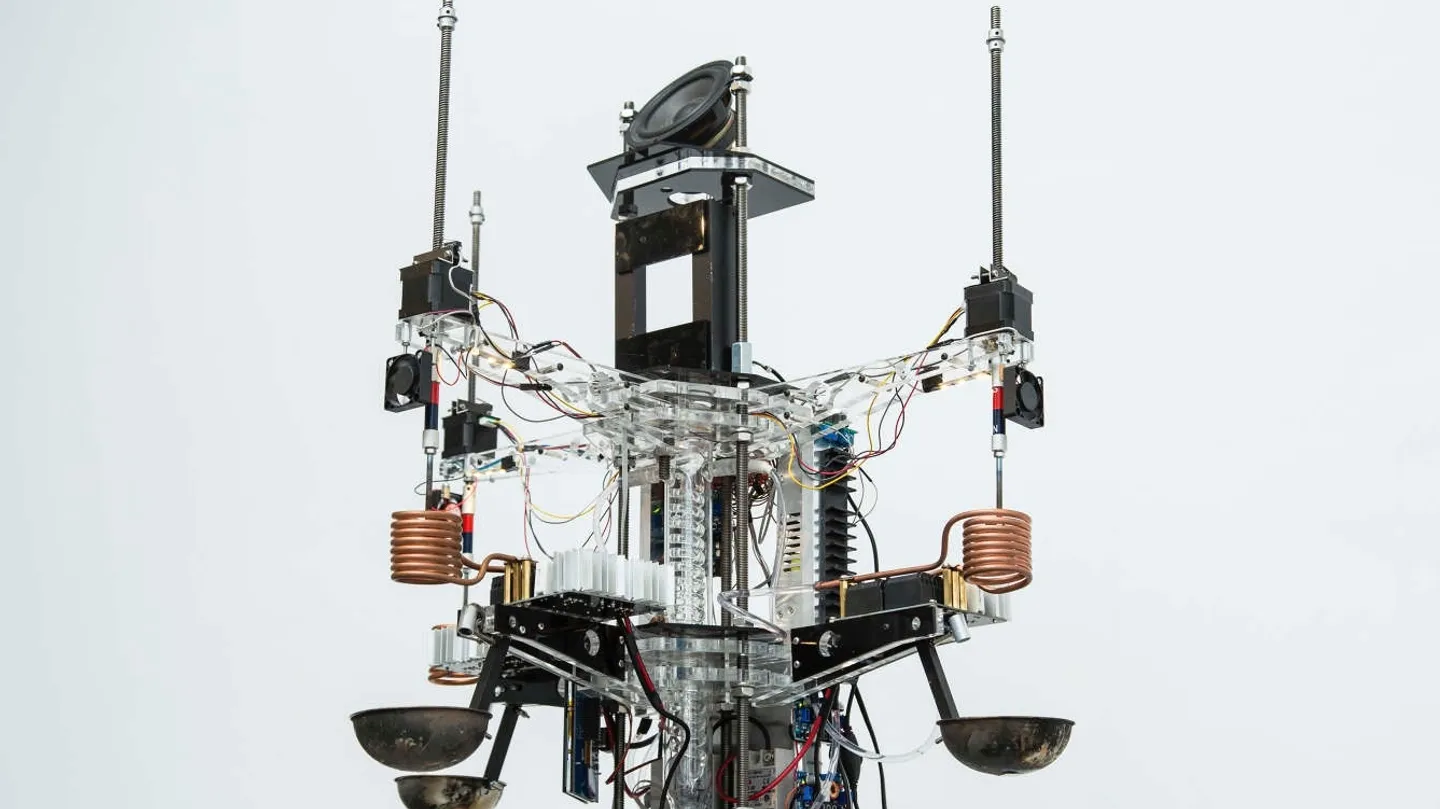
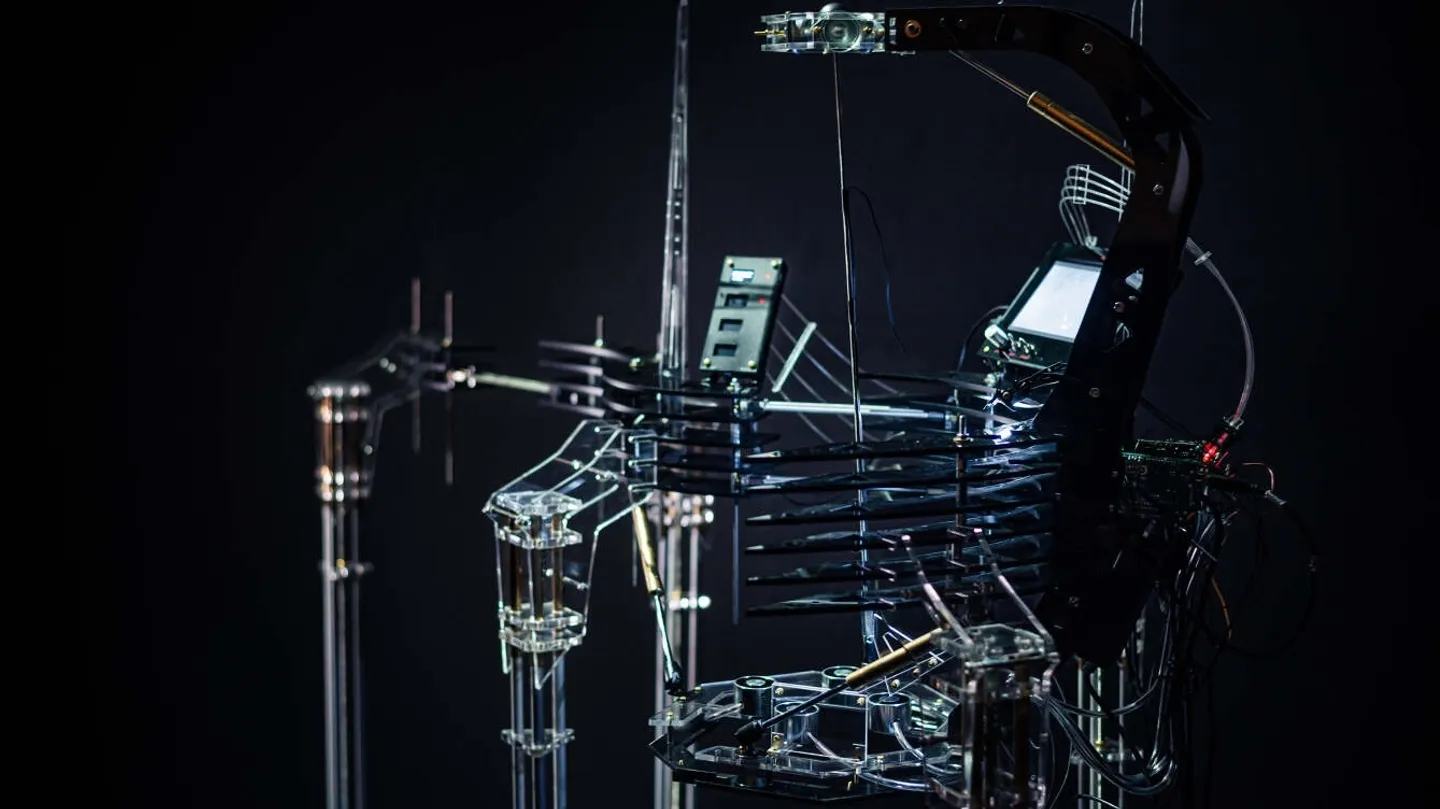
Poise→[d] is a hybrid installation that uses chemical and physical reactions to control its behaviour and sound synthesis. The installation consists of the main control unit and three balancing robots. The main control unit has three core systems where the reactions occur, with everything analysed by a computer algorithm using cameras.

This project is based on self-organising structures viewed from several different angles. All the three robots are connected to the main control unit and represent through sound and movement one of the three processes that are happening. The first robot is connected to a sound/mechanical process, the second one to a thermodynamic reaction, and the third to a chemical reaction. Taken together, they create a new and more complex system, as they affect each other through the movements of robots and the main algorithm. To a certain extent, this hybrid system consisting of robotised kinetic objects and chemical/physical reactions is symptomatic of pre-biotic chemical evolution. Another important aspect is the use of Belousov-Zhabotinsky’s chemical reaction - owing to its complexity and singularity, fascinating studies were conducted on cybernetics and some scientists were even enthused to create a chemical computing machine. In this project, the reaction is the most important component of the algorithmic process of the entire installation.

It boasts the following reactions/processes:

- A Belousov–Zhabotinsky reaction, otherwise known as a BZ reaction, is a classic case of non-equilibrium thermodynamics and the resulting creation of a nonlinear chemical oscillator. These reactions are important in theoretical chemistry, as they prove that chemical reactions are not necessarily dominated by equilibrium thermodynamic behaviour. As a result, they provide an interesting chemical model of non-equilibrium biological phenomena; as such, mathematical models and simulations of BZ reactions are of theoretical interest. Similar oscillatory spiral patterns can be found in nature in different spatial and temporal scales, for example, the growth pattern of Dictyostelium discoideum, a soil-dwelling amoeba colony. In the BZ reaction, the size of the interacting elements is molecular, while the reaction occurs in minutes. In the case of the soil amoeba, the size of the elements is typical of single-celled organisms, and the time involved can range from days to years. Investigators are also exploring the creation of a "wet computer", using self-creating "cells" and other techniques to mimic certain properties of neurons.

- The Rayleigh–Bénard convection is a natural convection that appears in a horizontal layer of fluid heated from below. Here the fluid develops a regular pattern of convection cells. These are known as Bénard cells. Thanks to the analytical and experimental accessibility of the Rayleigh–Bénard convection, it has become the gold standard for research on convection phenomena. The convection patterns provide examples of self-organising nonlinear systems.

- Audio feedback: a special positive loop gain occurring as a result of a sound loop between the audio input and output. Through the use of feedback properties, the system’s behaviour can be altered in accordance with the requirements of the application; systems can be made stable, responsive or held constant. Dynamic systems with feedback adapt in a similar way to the edge of chaos. In this project, feedback proceeds through a digital pitch shifter, which creates self-organising sound patterns and sequences based on the non-linear behaviour of the digital path passing through the air and affected by the robotic system.

All the four elements are suspended from the ceiling and are in a calm, self-stabilizing state. However, the movement of the three kinetic elements/robots sets all parts of the installation into motion, including the main unit where the reactions take place. This leads to a change in all the processes in the self-organizing structure, attributable to the extreme sensitivity of the reactions to mechanical vibrations and other vibrations. This, in turn, results in a failure in the self-organisation of reactions, which causes the robots to move less and the system to assume a quieter state. Here however, the conditions are once again created for the emergence of self-organising processes, and everything starts moving again. Thus, the system is self-regulating, resembling a complex organism or a multi-compound pendulum.

Abstracted from developments in the system, its behaviour can be viewed as a complex choreographic and sound-robotic sketch based on the complex patterns of the behaviour of its discrete elements.

The synthesis of sounds produced by the installation is based on an audio track from the old Soviet film Nonlinear Structures in Synergetics (1987) which describes various self-organising phenomena in biology, chemistry and physics. When synthesising the sounds, the installation program uses the spectral characteristics of different fragments of the sound of this film to resynthesise the timbres.

Self-organisation, which is also known in social sciences as spontaneous order, is a process where some form of general order arises from local interactions between the parts of an initially disordered system. The process is spontaneous, and as such does not need any control from an external agent. It is often triggered by random fluctuations and amplified by positive feedback. The resulting organisation is decentralised and distributed across all the components in the system. As such, the organisation is typically robust and able to survive or self-repair substantial perturbation. Chaos theory discusses self-organisation as islands of predictability in a sea of chaotic unpredictability. Self-organisation occurs in many physical, chemical, biological, robotic, and cognitive systems. Examples of self-organisation include crystallisation, the thermal convection of fluids, chemical oscillation, the swarm behaviour of animals, neural circuits, and artificial neural networks.

Science consultant - Prof. Alexey Bobrovsky, Chemistry Department of Lomonosov Moscow State University.
Authors
Tags