guest
About artwork
Provenance
Tech info
About
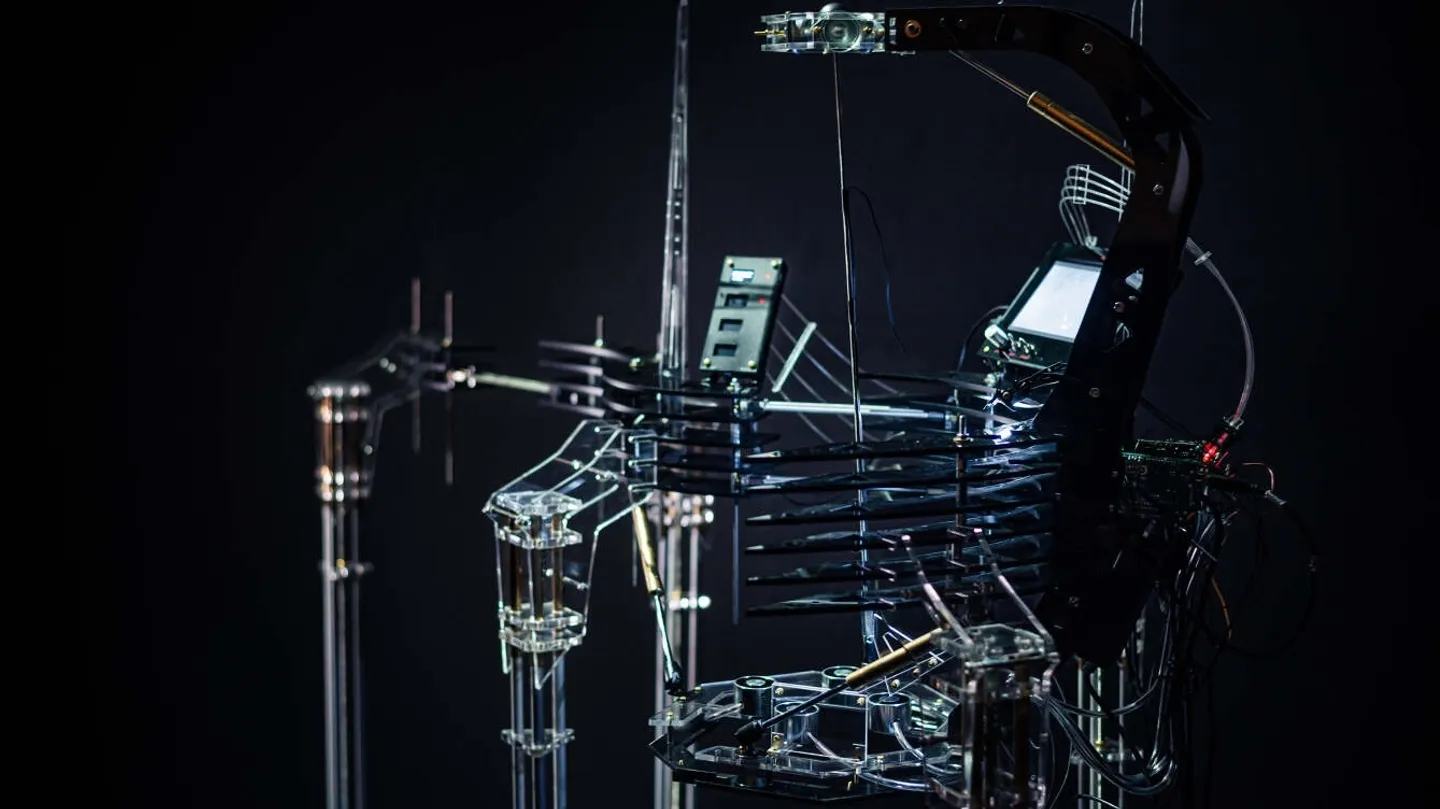
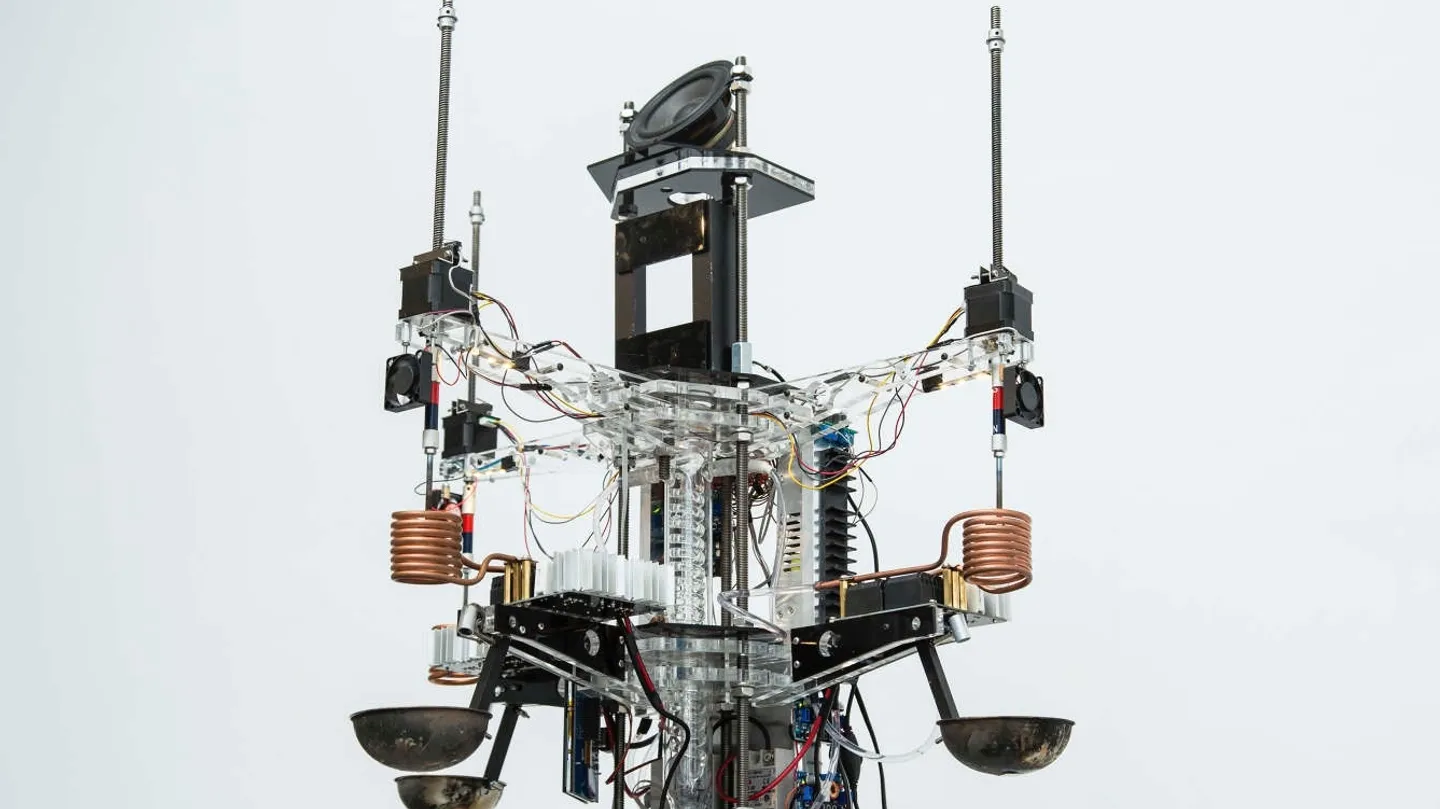
Multimedia installation. The project is a component, kinetic, electromagnetic and sound installation executed as a single structure/mechanism. Part of the Geological Trilogy.

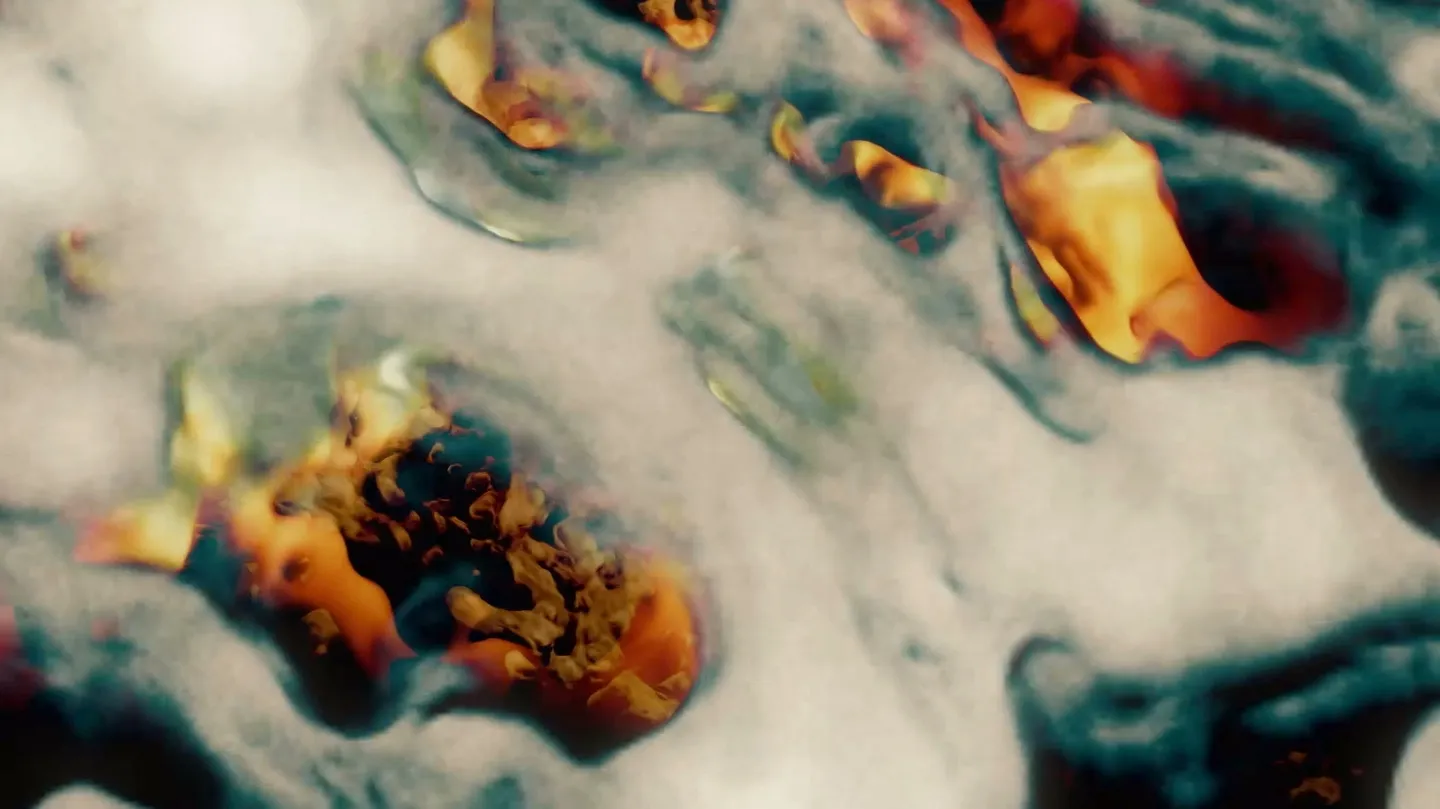
The key component of its operation is a system of three robotic mechanisms interacting with small iron meteorites (fragments and individual specimens). The interaction can be summed up as follows: at the start of the cycle, an automatic manipulator with a small passive magnet, to which the meteorites are magnetised, slides towards a powerful alternating magnetic field created by an induction coil. As a result, the meteorites become red hot within a short period of time (not more than a minute), attaining the approximate temperature of a falling meteorite that has entered the upper atmosphere. After attaining a temperature of approximately 750 degrees Celsius, the meteorites lose their magnetic properties (reach the Curie point) and become uncoupled from the manipulator, ending up in a special container. An infrared camera in the container holding the fallen red-hot meteorite transforms the thermal radiation into a picture. The cameras are connected to a small computer which analyses the temperature of the gradually cooling meteorites. The temperature data are pegged to the height of pitch of a simple sinusoidal generator, which reveals that the cooling of the meteorites leads to a gradual and modulated reduction of the sound pitch of the generator. After reaching ambient temperature, the meteorites are again hooked up to the magnetic manipulator (the meteorites recover their magnetic properties on cooling), and again ascend to the heating coil, launching the cycle anew.

As several meteorites differing in mass and size are used in the system simultaneously, all three mechanisms exist in different time cycles, with discordant phases, resulting in the emergence of common chords arising from the generators resonating simultaneously, but recording different temperatures.

To all intents and purposes, the installation is a cyclical system modelling the time of the “arrival of meteorites” on the earth – a virtually imperceptible and extremely rare situation. The main driver and inspiration for this work was the appearance in my geological collection of several individual fragments of the Sikhote-Alin meteorite, which fell in the Far East in 1947. This meteorite is unique for a number of reasons: it is the largest iron meteorite in recent history: its fall was witnessed by numerous people, including the artist Nikolayev, who was working outdoors at the time of the meterorite’s fall and documented his impressions in a painting that became very popular in the USSR. It is the most studied object to have ever fallen to earth. However, slivers and individual fragments can still be found at the point of impact.

The incredible drawing power of such rare “guests” from space prompted me to start on my artistic research, involving the trends in new media art of most interest for me: natural and artificial electromagnetism, work with sound, robotic automated systems, geology, astrophysics and astrogeology. Furthermore, each of these topics not only represents a way of attaining a holistic artistic image, but is also a separate mechanism establishing a synergy of separate aspects of the work. Implementation of the project involves not only the creation of the object itself, but also a journey with it to the Meteorite village located near the point of impact at the Sikhote-Alin Mountains (Maritime Territory).

The project culminated in siting the existing installation in one of the craters remaining after the fall of a fragment of the meteorite which had exploded in the atmosphere. This was an idiosyncratic way of recreating the time of impact directly at the point of impact of the meteorite. It would be apposite to call such a journey a pilgrimage/investigation, combined in the shooting of a short documentary dedicated to the whole process. Most of the meteorites used in the installation were found in one of the craters during the trip. Some samples were acquired from residents of the settlements near the point of impact.

The final format of the exhibit consists of a demonstration of the actual installation, as well as a film taken during the trip and archival materials related to the project: books, large meteorite fragments, diagrams and cards posted in a display.
Authors
Tags
![Poise→[d] by ::vtol::](https://cifra.com/content/static/meta/project/a1f23771-2772-4107-81ab-7f49e74b62e1/cover/1782395070/full_1440.webp)