Phytophonia_ Translating the Unspoken
About artwork
Provenance
Tech info
About
Phytophonia: Translating the Unspoken is a video installation that explores translation not as a
neutral transfer of information, but as a creative, technological, and political process that actively
reshapes meaning. The work proposes a speculative interface for interspecies communication,
in which biological activity is converted into sound and mediated through artificial intelligence,
revealing both the possibilities and distortions inherent in all acts of translation.
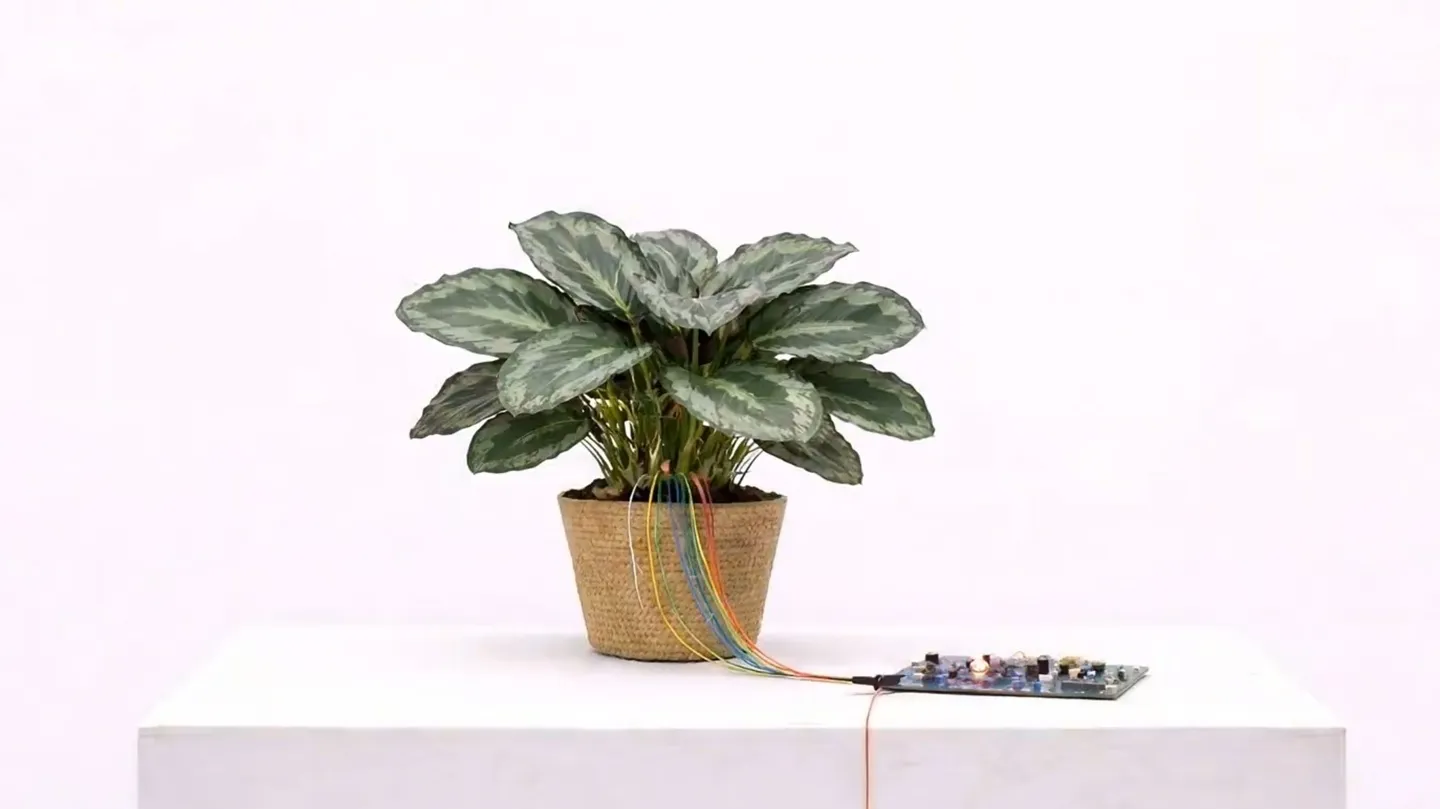
At the center of the visual field stands a single living plant, isolated within a white, institutional
space resembling a museum display. Thin electronic sensors are attached to its stem, capturing
micro-variations in electrical potential and conductivity—natural biological fluctuations influenced
by internal processes and environmental conditions. These signals do not constitute language
or intentional expression; they belong to a biological system that operates outside human
semantic frameworks.
The measured data is translated into control signals that drive a modular synthesizer system.
Instead of recording sound from the plant, the system converts biological variation into changes
in sonic parameters such as frequency, filtering, amplitude, and modulation. The resulting
soundscape is therefore not the plant “speaking,” but an acoustic construction shaped by
algorithmic mapping and machine response. Musical structure, rhythm, and emotional tone
emerge not from vegetal intention, but from the interpretive framework imposed by the
translation system itself.
This process positions sound as an invented language rather than a revealed one. Each
technical decision—how voltage maps to pitch, how fluctuation becomes rhythm, how noise
becomes harmony—introduces bias and aesthetic direction. What the audience hears is not
biological truth, but the emotional consequence of technological interpretation. In this way, the
work treats translation as a site where invention and distortion are inseparable from
communication.
The visual component of the work is generated using artificial intelligence. The AI does not
document the plant in real time, but produces a hyper-controlled, static, and idealized
representation of observation. The stillness of the image contrasts with the activity of the sound,
creating the illusion of a “live performance” while simultaneously revealing its artificial
construction. AI thus functions not only as a production tool, but as a second layer of
translation—reshaping organic presence into a stylized, institutionalized image of life under
observation.
Within this system, artificial intelligence becomes a speculative mediator species: positioned
between biological processes and human perception, filtering what can be seen and shaping
how it is emotionally processed. The work therefore reflects on how contemporary experience of
nature is increasingly mediated through data, interfaces, and algorithmic representation. What
appears as dialogue may also be a form of extraction, where living systems become legible only
after being converted into measurable and aestheticized information.
By isolating the plant from ecological context and presenting it as a monitored specimen, the
installation emphasizes the asymmetry of interspecies translation. The plant does not
communicate; it is interpreted. Its biological variability becomes raw material for technological
meaning-making. The blinking electronic indicators and synthetic sound draw attention to the
machinery of translation itself, rather than to any illusion of direct access to non-human
consciousness.
Within the framework of Translatio et Inventio, the project frames translation as a productive yet
unstable bridge between radically different modes of existence. Rather than offering access to
an authentic vegetal voice, Phytophonia foregrounds the impossibility of unmediated dialogue
and invites reflection on how all forms of translation—linguistic, cultural, technological, or
interspecies—do not merely transmit reality, but actively participate in its construction.
The work ultimately asks not whether we can hear plants, but how much of what we call
communication is shaped by the systems we build to listen.