Solar Prospects
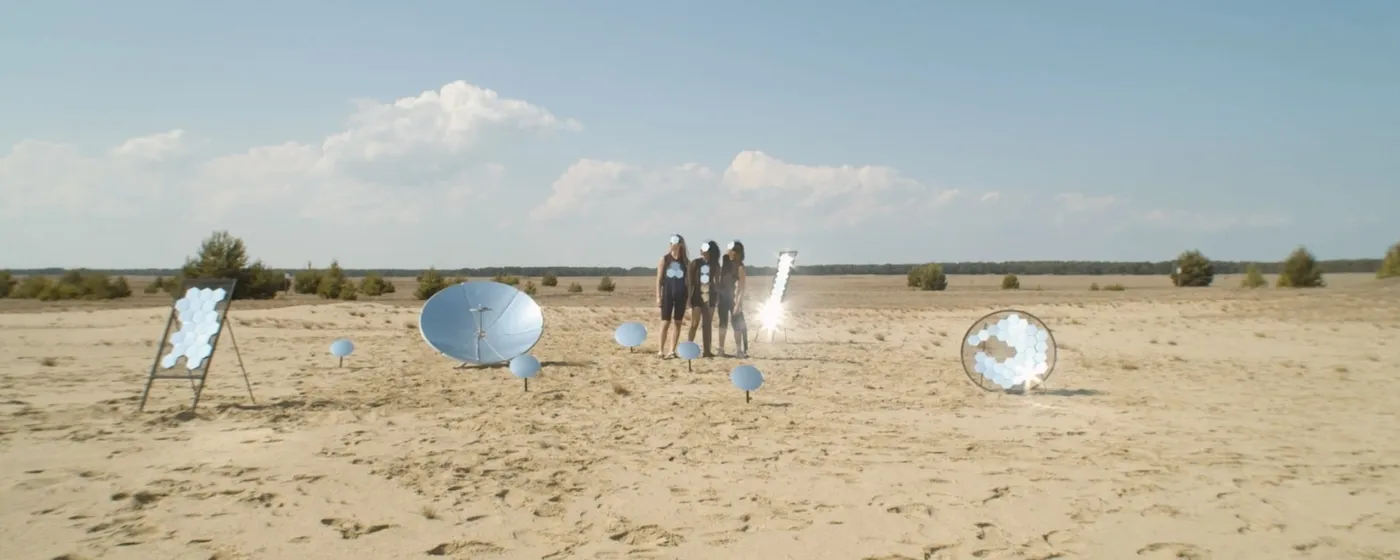
From CIFRA: What if the sun is not just light, but a force shaping how we live and change together? This online exhibition brings together works that look at solar energy beyond technology. The sun becomes a shared condition — cultural, ecological, and political. Start exploring and discover how these works reflect our shared relationship to energy and change. From Vanina Saracino: The sun is both a life-giving force and the engine of metabolic cycles for all living systems. But does its cosmic pulse also influence social dynamics and human cohesion? Soviet biophysicist Alexander Chizhevsky proposed a connection between solar cycles and human conflicts: he believed that when solar activity intensified, life would react in kind—becoming more agitated—which, in humanity’s case, led to social upheavals, revolutions, and what he called its “greatest madnesses.” This idea feels particularly timely, as solar activity has reached a peak within the current cycle (2024–2025), a period marked by intense flares and heightened solar phenomena that, according to Chizhevsky’s theory, could find echoes in global political events. 'Solar Prospects' departs from this notion and brings together a selection of video works that reimagine the sun not merely as a source of energy, but as a cultural, ecological, and political symbol that shapes humanity's complex relationship to sustainability, energy transition, and planetary processes. The works included in the program explore different aspects of the sun’s spiritual, political, socio-economic, and ecological implications, also considering the role of solar energy in the shift from fossil fuels toward renewable sources of energy. Can Chizhevsky’s visionary insights become a cosmic goggle through which to contemplate the enigmatic dance of energetic excesses and the unfolding of destructive manifestations in our present? Within the complex and deeply heterogeneous fabric of humanity, how do we, as individuals, artists, and societies, navigate the currents of solar energy held within our very essence, catalyzing both creative and destructive events that resonate with the dual pulse of stellar light? About the works: Ani Schulze’s 'Flint House Lizard' (2019) unfolds across four sun-oriented cycles, beginning in darkness and tracing the movements of a single body. While its protagonist seems to harness the sun’s energy, the work suggests that the sun itself may be the true agent. Drawing on Chizhevsky’s theory, it explores how solar forces move through individuals and societies. Amalia Valdés’s 'Arriba es abajo como el sol es la luna' (Above is below as the sun is the moon, 2018) recreates the Chakana, or Andean Cross—a recurring emblem in the Indigenous cultures of the Andes—using pieces of metallic paper. This ancestral symbol, filmed against the Milky Way above Chile’s Atacama Desert, embodies a cosmic bridge between high and low, human and divine, earth and universe. Also shot in the Atacama Desert, Elisa Balmaceda’s 'Agua de luna' (Moon Water, 2015) documents an intervention at the bottom of the largest crater in the Valley of the Meteorites, Quillagua. By using a reflective material that mirrors both sunlight and sky, Balmaceda creates an ephemeral pool or mirage, evoking the crater’s origins and the desert’s fragile balance of water, extraction, and illusion. In 'Is It Real?' (2025) Superposition collaborates with AI to imagine a futuristic city rising from the desert like a mirage. Blurring boundaries between nature and technology, the built and the organic, the work envisions solar energy as both power source and metaphor for the interplay between imagination and creation. Vincent Ceraudo and Benjamin Ramirez-Perez’s 'Sun Surface' (2020–2021) merges documentary and science fiction in Ordos, Inner Mongolia. Taking China’s rapid ascent as backdrop, the film probes ideas of growth, energy, and techno-scientific progress amid the climate crisis. A team of scientists maps a scorched landscape while grappling with temporal disorientation and a mysterious solar phenomenon. Maryna Makarenko’s 'Sun Eaters' (2023) draws from Eastern European science fiction to imagine a speculative evolutionary path in which humans metabolize sunlight like plants. Rooted in the geopolitics of military conflict and displacement, the work speaks of the urgency of transformation in the face of immobilizing systems. Fredy Moussa’s 'Solar Noon' (2022) unfolds between the Atlas Mountains and the Saharan plateau, where a dry lake divides the Mashreq and the Maghreb. Layering fragments from Herodotus’s Histories, oral traditions, and original text, Moussa composes a series of tableaux vivants that meditate on mutability, myth, and solar ritual. Kyriaki Goni’s 'Around the Same Sun' (2022) envisions stones as ancient memory-keepers whose intertwined cosmic and terrestrial histories (of extraction, colonization, technological acceleration, and space exploration) invite us to consider what stories Earth’s oldest matter might tell.

Countries
DE
IT
Tags




Pieces in playlist