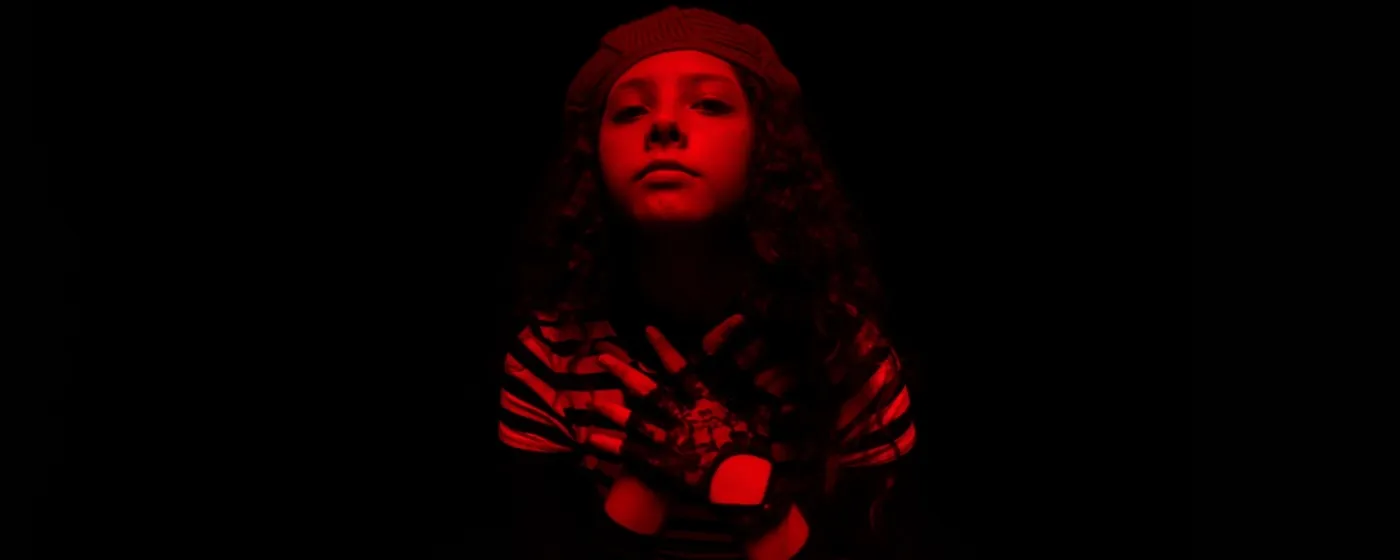
Nina E. Schönefeld: ART IS MY REVENGE
This exhibition was presented at CIFRA from November 1 to December 31, 2025, and may now be accessible only through trailers, documentation, or fragments rather than full artworks. The solo show brought together film-based works by Nina E. Schönefeld, unfolding as a cinematic sequence that moves through fear, media illusion, and resistance. In this solo exhibition, German artist Nina E. Schönefeld takes you on a cinematic journey through fear, hope, and resistance. Across a series of short films, you move through illusions, media noise, and digital decay—a world disturbingly close to our own. You can watch it in one continuous flow or pause between films to reflect; each piece opens a new chapter in the same unfolding story. What if catastrophe isn’t a single moment, but the world we already inhabit? We live in a world where the feeling of an impending doom has become the norm. What was once described as “the oblivion of being” and “the end of man” is now an everyday experience. Modernity exists in a state of “collapse": everything is accelerating, compressing, and losing depth. We can no longer distinguish between the real and the imaginary, and this catastrophic illusion—something Baudrillard wrote about—has become our natural environment. It is not an apocalypse, but a slow dissolution where fear, fatigue, and anxiety are not just reactions; they are the background against which we live. This is the state in which Nina E. Schönefeld works. Schönefeld uses the alienation of post-apocalyptic cinema aesthetics to tell site-specific, fictional stories and reveal their effects. Her films do not merely record events; they capture the tension of the present: decadence, loss of orientation, and the suspension between action and powerlessness. Schönefeld tries to revive radical resistance as a response to our increasingly disillusioned times. Through a specific visual language, the work focuses on a spirit of rebellion and a longing for change. She does not depict catastrophe itself but shows how we coexist with it. Her horror does not stem from monsters but from a weary norm where everything terrible has already happened, and we have simply become accustomed to it. Her focus is on hyperobjects—phenomena that cannot be perceived in their entirety but that influence everything around them. Themes such as digital illusion, media manipulation, viruses, nuclear waste, and oceans full of plastic recur in her films like haunting dreams, merging the personal and the political. These narratives are not separate but parts of a larger body that breathe anxiety and hope at the same time. In an impressively short span—around fifteen years—Nina E. Schönefeld has created an entire world. Her films, shown at a solo exhibition at KINDL – Zentrum für Zeitgenössische Kunst (2024/25, curated by Katrin Becker) and included in Rachel Rits-Volloch's program for CIFRA The Body: Any Body Knows, construct a distinct universe that is disturbing, precise, and deeply human. Given the quantity and scale of her work, this timeframe seems incredibly condensed, almost timeless. Schönefeld employs multiple media—video, sculpture, painting, and text—all of which are integral parts of a single expression, a unified intonation. Behind this multitude of forms lies a rare integrity: clarity of vision, inner discipline, and an almost quiet humanity that resonates in everything she does. Nina E. Schönefeld's aesthetic is characterized by its presence, conveying an almost physical fear that lingers long after viewing, remaining under the skin. The demonic images in her films are not external forces but shadows of our time. The artist engages with these images as if they were mirrors reflecting not monsters but our own selves. This is why her films are so poignant—they do not frighten; instead, they remind us: It is never too late to take up the fight. There is always light at the end of the tunnel. The exhibition progresses from illusion to action, beginning with P.A.R.A.D.I.S.E. (2023). Here, virtual images and social networks create a deceptive sense of peace, where control masquerades as pleasure. Nina E. Schönefeld shows how people willingly choose to live in this controlled illusion, where truth loses its meaning and simulation feels more real than life. In B.T.R. / BORN TO RUN (2020), the focus shifts to journalists—individuals who are meant to convey the truth but find themselves ensnared by the very system they seek to expose. Their race becomes a means of survival without sacrificing their voice in a world where words can be perilously costly. N.O.R.O.C. 2.3. (2020) serves as a moment of pause. The pandemic transforms time into a period of waiting and space into isolation. Familiarity vanishes, leaving only breath, fear, and the struggle to find meaning. Then comes C.O.N.T.A.M.I.N.A.T.I.O.N. (2021) and D.A.R.K. W.A.T.E.R.S. (2018), which address ecological catastrophes that silently underlie our existence unless we take the time to acknowledge the world around us. Radioactive waters and plastic-filled oceans are not mere metaphors; they represent a stark new reality. Nature is no longer just a backdrop but a mirror reflecting humanity's impending extinction. At this moment, we, the audience, face a simple yet profound question: WHY DO WE KILL (2022)? There is minimal action here—only a pause that invites reflection on how easily violence becomes normalized and empathy grows rare. But after the silence comes movement. R I D E O R D I E (2024) is a film about resistance and solidarity, about the human choice not to give up even when everything is crumbling. There are no heroes here, only determination. The finale of A.R.T. I.S. M.Y. R.E.V.E.N.G.E. (2020) serves as the artist's personal manifest —brief, precise, and almost whispered. Art is not a consolation or salvation but a form of action—the last vestige when all other forms of communication fail. It is no coincidence that each of Nina E. Schönefeld's films begins with a road, a landscape, or a view into the distance. The viewer is invited to embark on a journey, to choose their path in the (un)real world, and to confront their catastrophe and focus on the moment of decision when relentless, radical rebellion begins.
Countries
IT
JP
PL
GR
Tags
Authors in playlist
Pieces in playlist