XETRA EROSION -Erosion as a process-
Contains AI-assisted elements
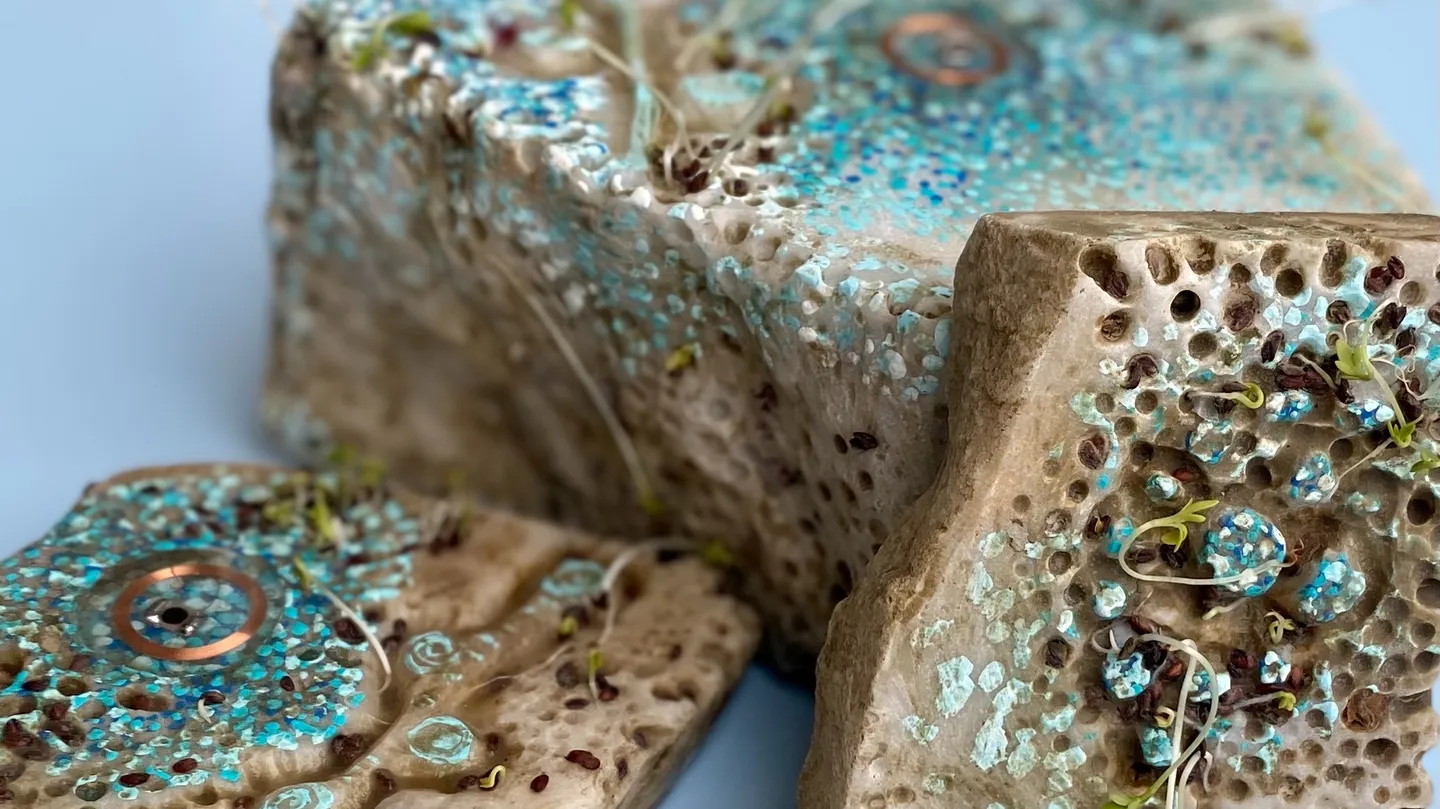
XETRA EROSION Jurgen Ostarhild, 2026 Erosion as a process. Erosion is not an event. It is a gradual transformation through time. Something loses substance, form, or stability. Not necessarily through destruction, but through continuous interaction with its environment. Matter: stone wears away through water, wind, friction. Information: meaning erodes through repetition, circulation, and loss of context. Structures: institutions lose authority. Systems lose coherence. The cultural sphere of speculation. The collapse of money and meaning. How it works A self-running market: corporations with ticker symbols and dollar values, workers circling their employers, crashes, bankruptcies and IPOs, a wealth-inequality index, a running headline and a scrolling ticker. No one intervenes. Every corporation is a block of gold built from small cubes, with a mirror-metal surface. The blocks drift and tumble slowly. Each collision erodes both bodies. The cubes nearest the point of contact break away, and the lighter body loses more. They fall, settle on the floor as dust, and slowly shrink to nothing. A corporation's value is the number of cubes it has left. A crash knocks 30 to 60 percent off the top of a block. A block that falls below a tenth of its former size goes bankrupt and collapses into dust. New corporations assemble themselves cube by cube: built up, then worn away. Information erodes too. Ticker symbols on the blocks and in the ticker lose their letters as their corporations lose substance, and each headline loses its letters while it is being read. The bar at the top right is the Gini coefficient of the market: how unevenly wealth is spread across the corporations on the floor. 0 means all are worth the same, 1 means one owns everything. It is green while the market is fairly even, turns orange above 0.38 and red above 0.55, as crashes and IPOs leave a few large blocks among many small, worn or newly built ones. It measures inequality between companies, not between people. Drag to turn and tilt the view, pinch or scroll to zoom. Tap to return to the start page. Link to realtime https://realtime.colorhuestate.com/xetra_erosion CONTEXT XETRA EROSION and the Accelerationist Promise In the 1990s, the philosopher Nick Land described capitalism as a process that dissolves everything solid: traditions, institutions, meanings, eventually the human subject itself. Where critics wanted to halt this dissolution, Land embraced it. For him, capital was an autonomous intelligence assembling itself out of the present, accelerating toward a point at which humanity would no longer be needed. XETRA EROSION shares the first half of this diagnosis and refuses the second. Here, too, the system runs without intervention. Corporations appear as solid blocks of gold, collide, and lose substance with every contact. Names lose their letters, headlines wear away as they are read. Nothing holds. But nothing arrives, either. There is no meltdown, no singularity, no future breaking through. The dissolution is not an event. It is friction, repetition, wear. What capital leaves behind is not a new intelligence but dust, which settles on the floor and slowly disappears. Land saw acceleration. The work shows erosion: the same movement, without the promise.