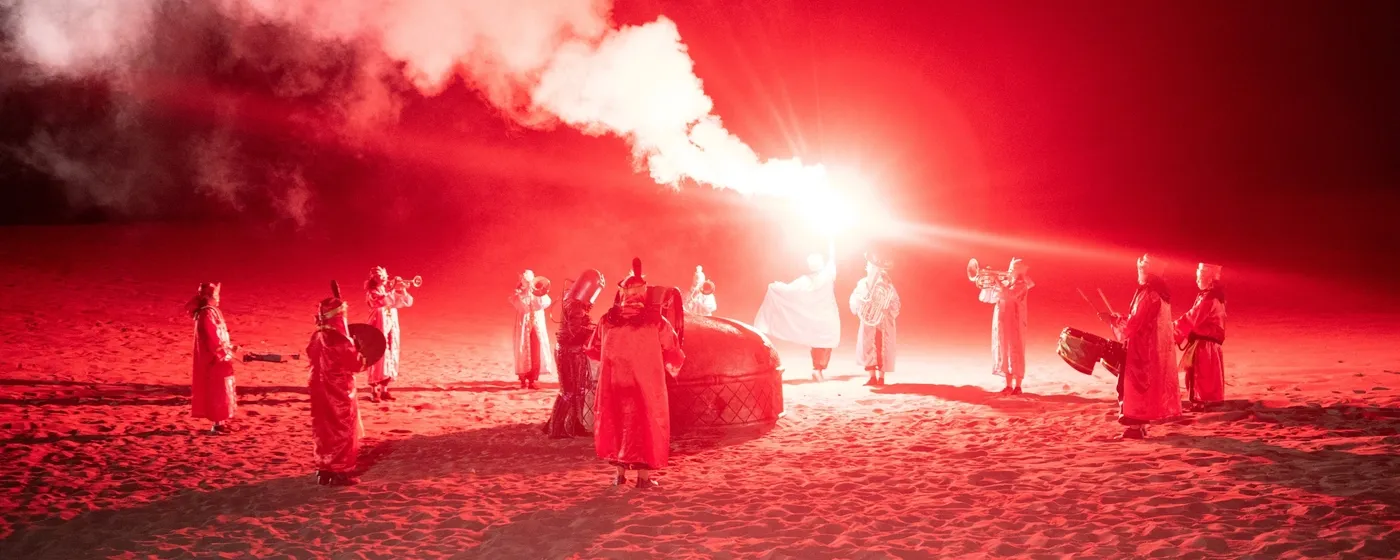
Riar Rizaldi: Hack the Black Box
Riar Rizaldi is first and foremost a filmmaker whose practice extends into contemporary art through auteur cinema, speculative fiction, and philosophical systems of knowledge. His practice straddles contemporary art, cinema, science fiction, documentary, and horror. For Riar Rizaldi, who lives and works in Indonesia, horror is not simply a genre or form of entertainment, but a way of observing reality. Horror emerges when a system becomes too large, distributed, and opaque to be directly observed. One of the artist's key interests is the coexistence of science and mysticism, not as opposites, but as different ways of describing the same reality. During his residency at CERN, Riar Rizaldi simultaneously explored quantum physics and Sufi philosophy, particularly the concept of Waḥdat al-wujūd, or the idea of the "unity of being," according to which matter, energy, consciousness, and the divine do not exist separately from one another. Based on this idea, we can sense how, in his works, digital technologies, resource extraction, mythology, geology, and the infrastructures of power are intertwined within a single complex system, where the boundary between the material and the invisible gradually begins to disappear. It's no coincidence that when we discuss physics, it's often represented by two states: the atom and the wave, the discrete and the continuous states. For Riar Rizaldi, reality is the state of an atomized structure, and the wave state is his artistic gesture. It's no coincidence that, since childhood, he dreamed of becoming a film director, for video not only creates additional context but also offers a completely different perspective on the reality we experience daily. Sometimes it seems as if everything around us comes in closed boxes: phones, platforms, delivery systems, infrastructures, cloud services — we use them every day, depend on them, but rarely question what exactly lies within and what kind of world makes their existence possible. Many systems today function precisely because they become invisible — the more efficiently a platform, logistics network, or digital interface functions, the less we notice the labor, violence, resources, and geography behind them. This is what makes Riar Rizaldi's practice particularly important today. His films don't so much explain systems as they make tangible the connections that are usually hidden behind the smoothness of a phone's casing and the familiar comfort of the robots that surround us. The ordinary object gradually ceases to be neutral. A phone begins to be perceived as a concentrate of geology, infrastructure, and vanished labor; a can of tuna as a trace of a global system of circulation and exploitation; and e-waste as the future archaeology of the technological age. The exhibition's structure develops like the gradual opening of a "black box." Through everyday objects — such as phones, wires, disassembled parts, and food packaging — we gradually encounter systems that typically remain hidden: resource extraction, logistics, platform labor, control infrastructures, and the ecological remnants of the digital age. But Riar Rizaldi's works don't offer a simple revelation; on the contrary, they constantly leave a sense of the world's incomplete legibility. Some systems cannot be fully seen. They can only be sensed through ghostly forms of presence. In many works, technology ceases to be a symbol of the future, becoming a ghost of the past. And the past is far more frightening, as humans generally live in the past, and it isn't always a bright spot, but more often a trauma that never heals. And perhaps it is precisely because of this that familiar reality begins to look a little different. KASITERIT (2019) Tin appears here as the hidden fabric of the digital world — a substance that connects earth, technology, and labor even after it disappears from view. From the materials within devices, Rizaldi gradually shifts attention to how technological systems are beginning to penetrate the very organization of human life. NEONATAL UNIT (2021) A signal from the future connects reproductive technologies, national identity, and the language of the collective "we." Behind the rhetoric of care and well-being, systems of control over the body, birth, and the very notion of the future gradually become apparent. BECQUEREL (2021) How do ideas of progress coexist with constant anxiety about the consequences? Behind the fantasy of an infinite resource of artificial sun or tropical nuclear energy, the instability of the environment itself is constantly felt. PYROCLASTS ARE ELOQUENT STORYTELLERS (2022) We observe Mount Merapi as a predictive system. Here, tension builds gradually, in a frightening state of anticipation and anticipation of a possible eruption. NOTES FROM GOG MAGOG (2022) The line between man and the system gradually blurs — all elements of this system are ghosts that enable our daily life processes. FOSSILIS (2023) Imagine yourself as an archaeologist — all electronic waste is a trace of our civilization, obsessed with renewal and cosmic speed. But consider this: beneath the smooth digital surface, the material world of metal and earth persists. MIRAGE: METANOIA — PRELUDE (2023) Quantum physics and Sufi metaphysics exist here as parallel attempts to describe the structure of reality. MIRAGE: EIGENSTATE (2024) The film combines quantum physics and Sufi metaphysics in a space where different models of reality begin to coexist simultaneously. Here, scientific knowledge ceases to be a universal system of explanation and exists alongside a mystical, intuitive, and imaginative experience of the world. LARUNG (2024) Here, the sea is linked not only to routes and trade, but also to the vulnerability of those "at sea." We are slowly and inexorably consumed by the sea's depths, and we are lost to the ocean floor. Fanfiction: Volcanology (2025) Here, colonial volcanology intersects with local mythology and mystical experience, where observation of nature can no longer be separated from personal immersion within it. The volcano becomes a space within which scientific knowledge and human imagination begin to coexist as parts of a single system of perception. We are all afraid to peer into a black box — we are afraid to see reality, the past and the future, to become lost within it, and never again to live as we once did. Riar Rizaldi's works exist precisely in this zone between the attempt to explain the world and the impossibility of making it fully legible. Here, cinema is not a means of documenting reality, but a way to sense its instability, like a volcano before an eruption. And perhaps it is precisely at this point between the visible and the hidden that reality itself resides today.

Countries
IT
JP
PL
GR
Tags
Authors in playlist

Pieces in playlist